
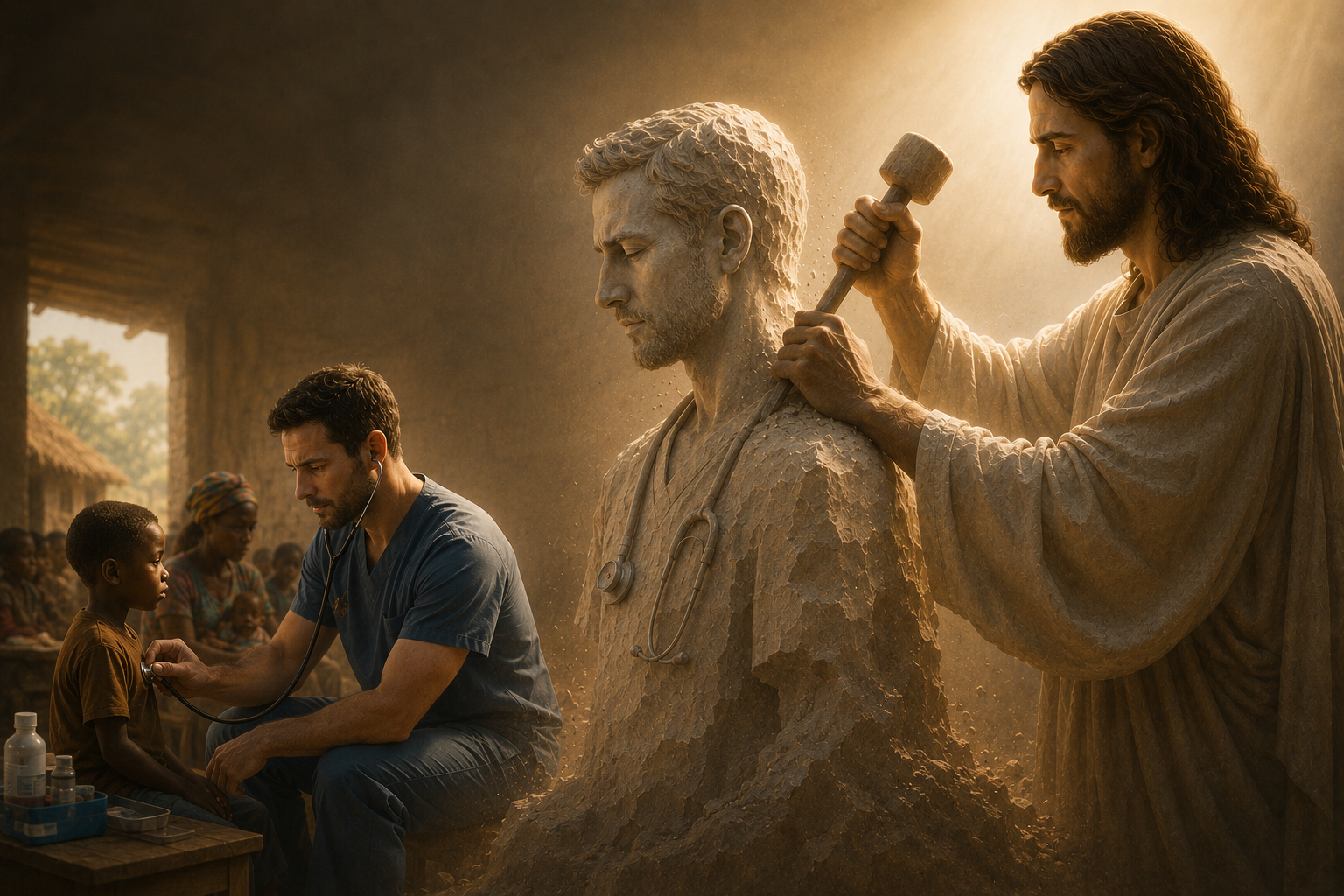
God Is As Interested in What He Does IN You As What He Does THROUGH You.
Summary of the series thus far
Part 1
The defining characteristic of a medical missionary is not medical knowledge but the love of God flowing through a human being. A medical missionary is a physician who becomes a representative of Christ rather than merely a dispenser of information.
Part 2
The first step in becoming a medical missionary is not working harder, learning more, or trying harder. It is learning to receive God’s love deeply enough that it naturally overflows into others. Where Does That Love Come From? It is received, not manufactured.
Part 3
The greatest obstacle to medical missionary work is not ignorance. It is self sitting on the throne of the heart. Peter becomes the prototype of the medical missionary because Peter had to be broken before he could truly serve.
The Entire Series in One Sentence.
To reduce all three articles in this series into one sentence: A medical missionary is a person who has received the love of God so deeply, surrendered self so completely, and been transformed by Christ so thoroughly that God’s love naturally flows through them to heal and restore others.
Medical missionary work is not fundamentally about teaching health principles or even combining medicine with evangelism. It is God’s method of reproducing the character of Christ in human beings, starting with the missionary, those they work with, and moving on to the people they serve.
Two Trajectories:
From a worldly point of view, success is measured by how high one climbs. Young professionals naturally absorb this worldview because virtually every educational system is built around it. Medical school, law school, business school, military academies, politics, corporate advancement—all are structured around progression upward.
The assumption becomes: The purpose of life is to rise. There is some truth in this. God often gives influence, responsibility, and leadership. But Scripture introduces a second trajectory, and from the World’s View, God’s trajectory is downwardly mobile before it is upward. This biblical pattern is remarkably consistent. Before exaltation comes humiliation. Before authority comes submission. Before leadership comes servanthood. Before resurrection comes crucifixion. Before the crown comes the cross. Not occasionally, but repeatedly. Almost universally.
What Makes This Relevant To Medical Missionaries
Many people enter medicine, ministry, administration, or leadership expecting that God’s calling will elevate them. Sometimes it does. But what they often do not anticipate is that God’s first priority is not using them. It is preparing them. And preparation frequently feels like loss.
A young physician may think: God called me to influence thousands. God may respond: First, I must teach you patience, or humility, or dependence, or compassion, or endurance, or how to love difficult people, or how to trust Him when your own plans collapse.
The tragedy is that many interpret this phase as failure. Joseph could have. Moses could have. Peter certainly did. But in hindsight we see that what looked downward was actually upward. God often leads His servants downward in order to take them higher than they could have gone otherwise. In God’s kingdom, God humbles those He intends to entrust with influence. So, in the end, it appears that God is often as much, or more, interested in what a calling is doing IN the worker than in what He is accomplishing THROUGH the worker. So now lets pick up in article 4.
The Calling Is Not Just About the Work
How to Make a Medical Missionary – Part 4
There is something deeply ingrained in the way most of us think about success. From an early age we are taught to move upward. We are encouraged to study hard, develop our talents, build our careers, increase our influence, and make something significant of our lives. The message is rarely spoken outright, but it is present everywhere around us: success is measured by how high a person climbs and how much influence they acquire along the way.
This perspective becomes especially powerful among highly motivated young professionals. Medical students, physicians, pastors, business leaders, administrators, attorneys, and entrepreneurs often spend years preparing themselves for greater responsibility. They invest enormous effort into education, skill development, and personal growth. There is nothing wrong with this. Excellence is a worthy pursuit. Competence honors God. Scripture never celebrates laziness, mediocrity, or neglect of duty.
Yet there is a question that modern culture rarely asks and that many young professionals never seriously consider.
What if God views a calling differently than we do?
Most of us naturally focus on what a calling will allow us to accomplish. We think about the people we will help, the influence we may gain, the contributions we hope to make, and the impact we want our lives to have. We imagine the work that lies ahead. We envision the mission. We think about the destination.
God often appears to focus somewhere else.
Again and again throughout Scripture, God seems remarkably interested in what the calling is doing to the worker while the worker is busy focusing on the work itself. While we are looking outward at the mission, He is looking inward at the heart. While we are measuring visible results, He is shaping our character.
While we are concerned about what He will accomplish THROUGH us, God is as concerned about what He will accomplish IN us.
Once this principle is seen, it appears almost everywhere in Scripture.
Joseph’s life provides one of the clearest examples. As a young man, Joseph received extraordinary promises from God. The dreams he received suggested leadership, influence, and divine purpose. From a human perspective, it appeared that God was preparing him for something significant. Yet immediately after receiving those promises, Joseph’s circumstances began moving in what seemed to be the wrong direction. He was betrayed by his own brothers, sold into slavery, separated from his father, falsely accused by Potiphar’s wife, and eventually forgotten in prison.
If Joseph had evaluated his life strictly by outward progress, he might have concluded that everything was falling apart. Instead of moving toward influence, he appeared to be moving further away from it. Yet when we look back upon his story, we discover that the prison was not evidence of God’s absence. It was evidence of God’s preparation.
The Joseph who emerged from prison was not the same Joseph who had entered it. The petted and favored son who once wore his father’s coat had been transformed. Years of hardship had taught him patience. Injustice had taught him trust. Disappointment had taught him dependence upon God. By the time he stood before Pharaoh, God had not merely prepared a ruler for Egypt. He had prepared a heart that could safely be entrusted with power.
The same pattern appears in the life of Moses. Raised in Pharaoh’s court and educated in the greatest empire of his day, Moses possessed every advantage the world could offer. He had position, opportunity, education, and influence. Yet before God could use him to lead Israel, He led him into forty years of obscurity in the wilderness.
Those years must have seemed bewildering. Moses had once stood near the center of worldly power, yet now he spent his days tending sheep in a remote desert. To human eyes, it looked like a tragic waste of potential. Heaven saw something entirely different. Egypt had taught Moses how human power operates. The wilderness taught him how dependence upon God operates. Egypt had cultivated confidence in his own abilities. The wilderness cultivated humility and trust in God. By the time God called Moses back to Egypt, He was no longer dealing with a self-confident prince eager to act. He was dealing with a servant who understood his need of God.
Daniel’s story reveals the same principle through different circumstances. Daniel eventually rose to extraordinary prominence. He advised kings, interpreted dreams, and influenced empires. Yet his rise began with loss. His homeland was destroyed. His future was interrupted. His freedom was taken away. His entire life was redirected by circumstances beyond his control. Then he was tempted to create a path for himself by simply indulging in a few of the king’s delicacies. Standing for God in what seemed like a small compromise may have felt extreme and even could have ended his life. In this we see that before God elevated Daniel, He taught him to surrender. Before God entrusted him with influence, He developed unwavering faithfulness. Character came before position.
Perhaps nowhere is this lesson more personal than in the life of Peter. Peter sincerely loved Jesus, yet much of his journey involved discovering how much confidence he still placed in himself. He trusted the training he had received in his field as a fisherman; he trusted his courage, his loyalty, and his understanding. Again and again, God allowed circumstances to expose what Peter could not yet see. The attempt to walk on water, the rebuke following his confession of Christ, the sword in Gethsemane, and ultimately the denial in the high priest’s courtyard all revealed the same reality. Peter loved Jesus, but Peter still trusted Peter.
Only after failure shattered that confidence did Peter begin to understand grace. Only after he stopped trusting himself did he become the kind of humble man who could be entrusted with caring for others. God was preparing an apostle, but before He prepared the apostle, He prepared the heart.
The pattern reaches its highest expression in Christ Himself. Paul tells us to let the mind of Christ be in us, then immediately describes a path that appears completely contrary to worldly ambition. Christ did not grasp for position. He emptied Himself. He became a servant. He humbled Himself and became obedient unto death, even the death of the cross. Yet the story does not end there. Paul continues by describing the exaltation that followed Christ’s humility.
The biblical pattern is unmistakable.
Humility precedes exaltation. Service precedes authority. The cross precedes the crown. This does not mean that God delights in suffering. Scripture never presents suffering itself as the goal. The goal is transformation. The objective is not pain but Christlikeness. God is not trying to make His people miserable. He is preparing them to reflect His character.
This truth stands in sharp contrast to many modern expectations. We often assume that God’s blessing will look like uninterrupted advancement. We expect obedience to produce immediate success and sacrifice to result in quick promotion. Yet Jesus repeatedly prepared His followers for a different experience. He spoke of carrying a cross, enduring misunderstanding, facing opposition, and exercising patience. He never hid the cost of discipleship. At the same time, neither did He hide the outcome.
Hebrews tells us that Christ endured the cross because of the joy set before Him. Isaiah says that after the suffering of His soul, He would see the fruit of His labor and be satisfied. Christ was willing to endure the process because He understood the result. That perspective changes everything.
Many people can identify a similar process in their own lives.
It may be the relentless demands of medical school, residency, seminary, or another season of preparation that seems determined to expose every weakness and bring them to the end of themselves. It may be the weight of an administrative assignment that stretches them beyond what they thought they could bear, or the painful loss of that assignment because they chose to stand for principle rather than convenience. It may be the loneliness of serving in a difficult mission field and wondering whether anyone remembers their sacrifices, or the experience of facing misunderstanding, injustice, or even deliberate cruelty while sincerely trying to do God’s work. These become our prisons of Joseph, our wilderness experiences of Moses, our moments of decision like Daniel, and our crosses borne in fellowship with Christ.
Such experiences are not valuable because suffering itself is desirable. Nothing would be more discouraging than believing our pain had no purpose. Rather, they become meaningful because God is using them as part of a larger work of transformation. Through them He teaches trust when circumstances seem confusing, faith when answers are delayed, and love when bitterness would be easier.
What feels like the completion of our preparation—a graduation, a promotion, a new assignment, or a long-awaited opportunity—may actually be only the beginning of a deeper process. God sees needs within us that we often do not recognize ourselves, and He continues His patient work until the character of Christ is more fully formed in us. His goal is not merely that we accomplish a task, but that we become people whose hearts are marked by perfect love, unwavering trust, and enduring faith.
The value of a process is determined by its outcome.
When God allows disappointment, delay, difficulty, or even suffering into the lives of His children, He is not abandoning them. He is shaping them. He is teaching lessons that cannot be learned from books, lectures, promotions, or success alone. He is teaching humility, patience, perseverance, dependence, trust, compassion, and love.
Perhaps this is why one of the most important truths a medical missionary can learn is that God is often more interested in what a calling does IN the worker than in what He does THROUGH the worker.
The work matters. The patients matter. The mission matters. The people matter. Yet while we are busy serving others, God is quietly accomplishing His own work within us. The calling becomes a classroom. The ministry becomes a curriculum. The mission becomes the means by which God shapes the worker into the image of Christ.
Eventually, God may entrust influence. He may entrust leadership. He may entrust responsibility. Joseph eventually governed Egypt. Moses led a nation. Daniel advised kings. Yet by the time those positions arrived, the most important work had already taken place. God had prepared hearts that could carry responsibility without being destroyed by it.
The question then becomes how anyone can willingly embrace such a process.
The answer brings us back to the central theme of this series.
Love.
Only the love of God makes surrender reasonable. Only the love of God makes humility attractive. Only the love of God makes it possible to trust when we do not understand what He is doing. We do not willingly follow difficult paths because suffering is enjoyable. We follow because we have come to trust the One who is leading us.
When a person truly receives the love of God, something changes deep within the heart. The fear of loss begins to diminish. The need for recognition begins to loosen its grip. The desire to control outcomes begins to surrender. Gradually, Christ takes His rightful place upon the throne of the heart.
At that point, we begin asking a different question. Instead of asking only what God intends to accomplish THROUGH us, we begin asking what He intends to accomplish IN us. We discover that every assignment, every disappointment, every delay, every success, and every trial can become part of His work of transformation.
The path does not always move in the direction we expect. At times it may appear to descend before it ascends. Rather than a path to upward mobility, it may appear as a path of downward mobility. Yet every step is leading toward the same destination: a deeper reflection of the character of Christ.
Receive His love deeply enough to trust that process. Receive it fully enough to believe that His plans are wiser than your own. Receive it so completely that surrender becomes natural, obedience becomes joyful, and humility becomes beautiful. Then the love that transformed your life will begin flowing naturally into the lives of others.
That is how God makes a medical missionary.
And that is how He prepares a soul for eternity.
The author invites you to comment on this article. Whether you agree or have a different perspective, please enter your comments in the space below.
Leave a Reply
You must be logged in to post a comment.